Top 10 Best POS Software of 2026: The Ultimate List for Growing Businesses
Discover the best POS software of 2026. From retail to restaurants, we review the top 10 systems — and why Zubizi is the perfect middle ground: full-featured, easy to use, and available both online and offline.


If you’re reading this, you probably know the struggle: keeping track of inventory on one screen, billing on another, and manually calculating GST at the end of the day. It’s exhausting.
In 2026, a Point of Sale (POS) system isn’t just a cash register; it’s the brain of your business. It manages your stock, tracks your customers, and tells you exactly which products are making you money (and which ones are just gathering dust).
But here’s the real problem nobody talks about: most powerful software is too complicated for everyday use, and most easy-to-use software is too basic to actually run your business.
Tally is powerful — but your counter staff won’t figure it out without weeks of training. Square is easy — but it won’t handle your GST, godowns, or multiple warehouses. Marg has everything — but opening it feels like stepping back into 2005.
So where’s the sweet spot?
That’s exactly what this list is about. I’ve researched and reviewed the top 10 POS systems of 2026, so you can find the one that actually fits your business — not just the one with the most features or the fanciest marketing.
1. Zubizi — The Best Middle Ground: Full-Featured, Easy to Use, Cloud + Offline
Let’s start with the one we built, because we believe it genuinely solves a problem the others haven’t.
The problem with most business software is a trade-off: You either get power or simplicity. You get cloud or offline. You get enterprise features or something your staff can actually use. With Zubizi, we refused to accept that compromise.
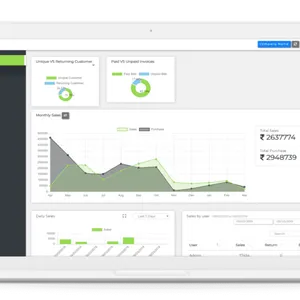
What it is: A complete ERP and POS system for Indian retail businesses — built to have everything Marg, Tally, and Busy offer, presented the way a modern app should feel.
The core idea: Zubizi packs all the depth of full-featured accounting and inventory software into an interface that a first-time user can navigate without training. That’s not easy to build. But that’s what separates Zubizi.
Full-Featured — Like the Industry Giants
Zubizi doesn’t cut corners on features. It handles everything your business actually needs:
- GST billing and tax filing — correct, compliant, and automated.
- Advanced inventory management — multi-godown, barcode scanning, stock transfers, expiry tracking.
- Purchase and sales management — full order lifecycle from PO to payment.
- Customer and party ledgers — credit limits, outstanding dues, payment history.
- Detailed MIS reports — profit & loss, stock valuation, party-wise summaries.
- WhatsApp integration — send invoices and reminders directly from the system.
This is the depth you’d expect from Tally, Marg, or Busy — without having to call your accountant every time you need to run a report.
Easy to Use — For Real People, Not Just Power Users
Zubizi was designed with one principle: your counter staff, your billing clerk, and even your shop owner should be able to use it from Day 1.
No jargon-heavy menus. No hidden sub-ledgers. No 47-step process to generate an invoice. The workflow is clean, fast, and intuitive — built for people who run businesses, not for people who study software.
This is Zubizi’s real differentiator. The same features that accountants love are accessible to anyone behind the counter.
Cloud + Desktop — You Choose
This is where Zubizi becomes truly flexible:
- Online (Cloud-based): Work from anywhere. Your shop in Delhi, your accountant in Pune, your second branch in Hyderabad — everyone on the same data, in real time. No server setup, no IT headaches.
- Offline (Desktop + LAN): No internet? No problem. Run Zubizi completely offline on your local network. Multiple billing counters, one store — all synced via LAN. Your data stays on your hardware, under your control.
Most software forces you to choose one or the other. Zubizi gives you both. Pick what works for your setup — and switch if your needs change.
Who it is for: Garment shops, apparel stores, departmental stores, and small-to-medium retail businesses that want the full power of enterprise software, the ease of a consumer app, and the flexibility to work online or offline.
Pros:
- Full feature set — rivals Marg, Tally, and Busy in depth.
- Truly easy to use — zero-training interface for day-to-day operations.
- Cloud + Offline flexibility — use it on LAN at one location or across the internet from anywhere.
- Built for India — GST, Indian accounting standards, local workflows baked in.
- Modern, fast UI — no more feeling like you’re using software from 2005.
Cons:
- Less optimized for full-service restaurants (dedicated F&B software like Petpooja may suit better).
- Still growing its user base — not yet as widely recognized as legacy players.
2. Square POS — Best for Small Businesses & Startups
What it is: A globally recognized POS known for its sleek white hardware and ease of use.
Why I like it: It has the lowest barrier to entry. You can sign up and start selling in minutes. The hardware is beautiful and reliable.
Who it is for: Pop-up shops, cafes, and small retail businesses just getting started.
Pros:
- No Monthly Fees: Pay only per transaction (standard processing fees apply).
- Great Hardware: Reliable and aesthetically pleasing.
- User Friendly: Very easy to learn.
Cons:
- Transaction Fees: Can get expensive as you scale up.
- Limited Advanced Features: Lacks the deep inventory and accounting tools growing businesses need.
3. Shopify POS — Best for Omnichannel Sellers
What it is: The powerhouse of e-commerce that seamlessly connects your online store with your physical shop.
Why I like it: If you sell online, this is a no-brainer. Your inventory syncs in real-time. Sell a shirt in-store, and it updates on your website instantly.
Who it is for: Brands that sell both online (D2C) and offline.
Pros:
- Unified Inventory: Complete sync between web and store.
- App Ecosystem: Thousands of apps to add any feature you can imagine.
Cons:
- Cost: Monthly subscription plus transaction fees can add up.
- Dependency: You are locked into the Shopify ecosystem.
4. Lightspeed — Best for Detailed Inventory
What it is: A robust cloud POS tailored for retailers with complex, large inventories.
Why I like it: It offers granular control over stock. If you have thousands of SKUs and need deep reporting, Lightspeed shines.
Who it is for: Bike shops, jewelry stores, and multi-location retailers.
Pros:
- Deep Analytics: Incredible reports to understand your sales.
- Multi-Store: Excellent management for chains.
Cons:
- Learning Curve: Can be a bit complex to set up.
- Price: On the higher end of the spectrum.
5. Marg ERP — Best for Pharma & FMCG Distribution
What it is: A veteran in the Indian software market, widely used for distribution and pharma retail.
Why I like it: It is the standard for Pharma flexibility. Almost every chemist knows how to use it. The feature depth for pharma-specific workflows is unmatched.
Who it is for: Pharmacies, FMCG distributors, and supermarkets.
Pros:
- Industry Standard: Massive user base in India.
- GST Ready: Accurate tax reports and compliance.
- Feature Depth: Handles complex distribution scenarios.
Cons:
- Outdated UI: The interface feels like it belongs in the early 2000s.
- Steep Learning Curve: Can be overwhelming for new users without training.
6. Petpooja — Best for Restaurants in India
What it is: A dominant player in the Indian F&B space, powering thousands of restaurants.
Why I like it: It speaks the language of Indian restaurants. Integrates flawlessly with Swiggy and Zomato.
Who it is for: Restaurants, cafes, and cloud kitchens.
Pros:
- Aggregator Integration: Manages all online orders in one place.
- Menu Management: Easy to update items and prices.
Cons:
- Support: Reviews on support can be mixed.
- Niche: Not suitable for retail or product-based businesses.
7. TallyPrime — Best for Accounting-First Businesses
What it is: The undisputed king of accounting software in India that also offers POS capabilities.
Why I like it: Your chartered accountant loves it. If your primary worry is the ledger and tax filing, Tally is the safe bet. It’s trusted by millions.
Who it is for: Businesses where accounting compliance is the #1 priority.
Pros:
- Trust: Universally accepted by Indian CAs and auditors.
- Stable: Rock-solid, battle-tested performance.
- Compliance: Excellent GST and statutory reporting.
Cons:
- Not a True POS: The billing interface is clunky compared to modern apps.
- Hard to Use: Requires proper training — your counter staff won’t pick it up easily.
- Desktop First: Cloud features are limited compared to cloud-native alternatives.
8. GoFrugal — Best for Supermarkets
What it is: A digital-first company offering ERP solutions for retail, restaurant, and distribution.
Why I like it: It is reliable and scalable. They have a good mobile app ecosystem for owners to track business on the go.
Who it is for: Supermarkets and hypermarkets.
Pros:
- Scalable: Grows with your business.
- Support: Generally good customer service.
Cons:
- UI/UX: Functional but not the most modern design.
- Cost: Implementation can be expensive.
9. VasyERP — Best Cloud-Based Retail ERP
What it is: A modern cloud ERP that is gaining traction for its smart manufacturing and retail features.
Why I like it: It is accessible from anywhere. You can check your store’s performance from your holiday destination.
Who it is for: Retailers who want unmatched cloud accessibility.
Pros:
- Cloud Native: Access from any device, anywhere.
- Feature Rich: Specific modules for different retail types.
Cons:
- Internet Dependent: Needs a stable connection — no offline fallback.
10. Busy Software — Robust Accounting & Billing
What it is: A strong competitor to Tally, known for its powerful inventory and billing features.
Why I like it: It strikes a good balance between strict accounting and usable inventory management. Traders and wholesalers swear by it.
Who it is for: Traders and distributors who need more than just basic accounting.
Pros:
- Feature-Packed: Handles complex billing and multi-party scenarios.
- Reporting: Excellent MIS reports.
Cons:
- Desktop Based: Primarily an on-premise, offline-only solution.
- Dated Look: Functional but the UI shows its age.
The Bottom Line
Here’s the honest summary of the Indian POS landscape in 2026:
| Software | Full Features | Easy to Use | Cloud | Offline/LAN |
|---|---|---|---|---|
| Zubizi | ✅ | ✅ | ✅ | ✅ |
| TallyPrime | ✅ | ❌ | ⚠️ Limited | ✅ |
| Marg ERP | ✅ | ❌ | ❌ | ✅ |
| Busy Software | ✅ | ❌ | ❌ | ✅ |
| Square | ❌ | ✅ | ✅ | ❌ |
| Shopify POS | ⚠️ | ✅ | ✅ | ❌ |
The pattern is clear: powerful software is hard to use, and easy software isn’t powerful enough.
Zubizi is built to be the exception. It carries the full feature weight of Marg, Tally, and Busy — but in an interface that feels like a modern app. It works online for businesses that want cloud access from anywhere, and it works completely offline over LAN for shops that want speed, privacy, and zero internet dependency.
That’s the Zubizi promise: full power, real simplicity, your choice of how you run it. And if you run a garment shop, an apparel store, a departmental store, or any small-to-medium retail business — Zubizi was built with you specifically in mind.
If you want enterprise-grade software that your team can actually use from Day 1, try Zubizi — the middle ground Indian retail has been waiting for.