What is a GS1 Barcode? The Complete Guide for Indian Business Owners (2026)
Everything you need to know about GS1 barcodes in India. Learn why they are mandatory for Amazon, how to register, and the difference between local and global barcodes.


If you are manufacturing your own products - whether it’s pickles, garments, or electronics - you eventually reach a point where you want to grow beyond your local neighborhood.
You try to list your product on Amazon or approach a big supermarket chain like Reliance Smart. And immediately, they ask you for one thing: “Do you have a GS1 Barcode?”
You might be wondering, “I already have a barcode sticker on my product that my billing software printed. Why isn’t that enough?”
This is the most common confusion I see among Indian business owners.
In this guide, I will de-mystify exactly what a GS1 barcode is, why the “free” barcodes you print yourself won’t work online, and how you can get registered without spending a fortune.
What is a GS1 Barcode?
A GS1 Barcode is a globally standardized product, identifiable by a unique number (GTIN).
Think of it like a Passport for your product.
Just as your Aadhaar card identifies only you in India, a GS1 barcode identifies only your product across the entire world.
- The Structure: In India, these barcodes usually start with the prefix 890. This code tells any scanner in the world that the product originates from a registered Indian company.
- The Organization: GS1 is a non-profit global organization that manages these standards. They ensure that no two products in the world have the same number.
Why is it Important?
You might think, “Can’t I just use a random number?”
You can, if you only sell inside your own shop. But the moment your product leaves your shop, you need GS1.
1. Global Acceptance
If you export your garments to Dubai or the UK, a local barcode is useless. A GS1 code is scanned and recognized by retailers in 150+ countries.
2. Mandatory for Online Marketplaces
If you want to sell on Amazon India, Flipkart, JioMart, or BigBasket, you generally cannot list your product without a GTIN (Global Trade Item Number). These platforms use the GS1 database to verify that you are the legitimate brand owner.
3. Brand Trust
When a customer scans your product using a verified app (like the “Smart Consumer” app), they see your company name. It proves you are a professional, registered brand, not a fly-by-night operator.
GS1 Barcode vs. Local Barcode
Here is the simple difference that saves business owners a lot of headaches.
| Feature | Local Barcode (Proprietary) | GS1 Barcode (Standard) |
|---|---|---|
| Who creates it? | You (using software like Zubizi). | GS1 India Authority. |
| Cost | Free. | Paid (Registration Fee). |
| Uniqueness | Unique only in your shop. | Unique in the whole world. |
| Usage | Internal billing only. | Amazon, Retail Chains, Exports. |
| Example | 001-SHIRT-RED | 8901234567890 |
The Bottom Line: Use local barcodes for internal tracking. Use GS1 barcodes for selling to others.
Step-by-Step Registration Process for GS1 Barcodes
Getting a barcode is a formal process, but it is straightforward if you follow these steps. The entire process usually takes 7-10 working days.
Step 1: Start the Application
- Go to the official website: gs1india.org.
- Click on the “Get a Barcode” button.
- Select “Access the registration form”.
- You will need to fill in all your company details here to begin the process.
Step 2: Upload Required Documents
The documents you need depend on your company structure. Make sure you have these scanned and ready:
- Proof of Identity: Applicant company’s PAN card (or Proprietor’s PAN for proprietorships).
- Proof of Turnover: Balance sheet page showing turnover for the year ending 2024 or 2025 (Not required for new companies).
- Request Letter: A formal letter on your company letterhead requesting barcode allotment.
- Cancelled Cheque: A copy of a simple cancelled cheque from your company account.
- Entity Registration Proof:
- Proprietorship: GST certificate.
- Partnership: GST certificate or Partnership Deed.
- Pvt/Public Ltd: GST certificate AND ROC Certificate or MOA.
- Others (Society/HUF): GST certificate or ROS certificate.
Step 3: Pay the Registration Fees
Once your documents are submitted, you need to pay the fees. The cost consists of a Registration Fee, Annual Subscription, Security Deposit, and GST.
Here is a Fees Calculation Example (for a typical registration):
| Component | Amount |
|---|---|
| Registration Fee | Rs. 26,000 |
| Annual Subscription Fee | Rs. 12,250 |
| Security Deposit | Rs. 3,000 |
| Subtotal | Rs. 41,250 |
| GST (18%) | Rs. 6,885 |
| Total Fee Payable | Rs. 48,135 |
[!NOTE] This is just an example calculation. Your actual fee may vary based on your company’s turnover and the number of barcodes you apply for. You can find the latest fee structure on the GS1 India Fee Chart.
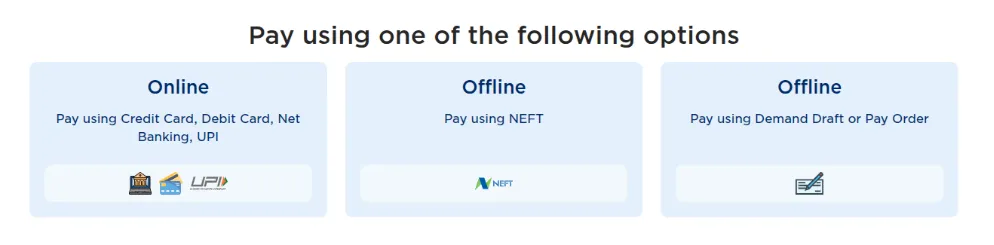
Payment Options: You can pay online (Credit/Debit/Net Banking) or offline (NEFT/Demand Draft).
Step 4: Allocation
After you submit the form, documents, and fees, GS1 India will verify your application.
- Timeframe: It typically takes 7-10 working days.
- Once approved, you will receive your Company Prefix and access to the DataKart portal.
Important Rules You Must Know
Before you apply, keep these critical points in mind to avoid rejection or wasted money:
- Brand Owner Only: Only the Brand Owner can apply. If you are a job worker manufacturing for someone else, the brand owner must apply themselves.
- Separate Applications: If you manage multiple different companies, you must apply separately for each entity.
- Choose Capacity Wisely: You can apply for batches of 100, 1,000, 10,000, or even 1,00,000 numbers.
- Tip: You cannot change this later. If you have 80 products today but plan to launch 50 more next year, do not buy the 100 pack. Buy the 1,000 pack to be safe. If you exhaust your limit, you will have to pay for a full new registration.
- Renewal is Mandatory: Your barcode subscription is not a one-time purchase. You must renew it annually before the expiry date to keep your barcodes active.
Conclusion
A GS1 barcode is more than just a sticker. It is your product’s entry ticket to the big leagues. Whether you want to sell on Amazon or stock your products in a mall, this small code makes it possible.
However, once you have your GS1 codes, you still need a way to manage them, print labels, and bill customers.
This is where we help. Zubizi works perfectly with both worlds. You can scan your official GS1 barcodes to bill customers, AND you can generate free local barcodes for loose items that don’t need global tracking.
Ready to professionalize your billing? Try our GST Billing & Invoicing Software today.