Complete Guide to Garment Manufacturing in India for Businesses
Discover the 6 types of garment manufacturers in India, their unique workflows, and step-by-step processes to optimize your manufacturing operations.

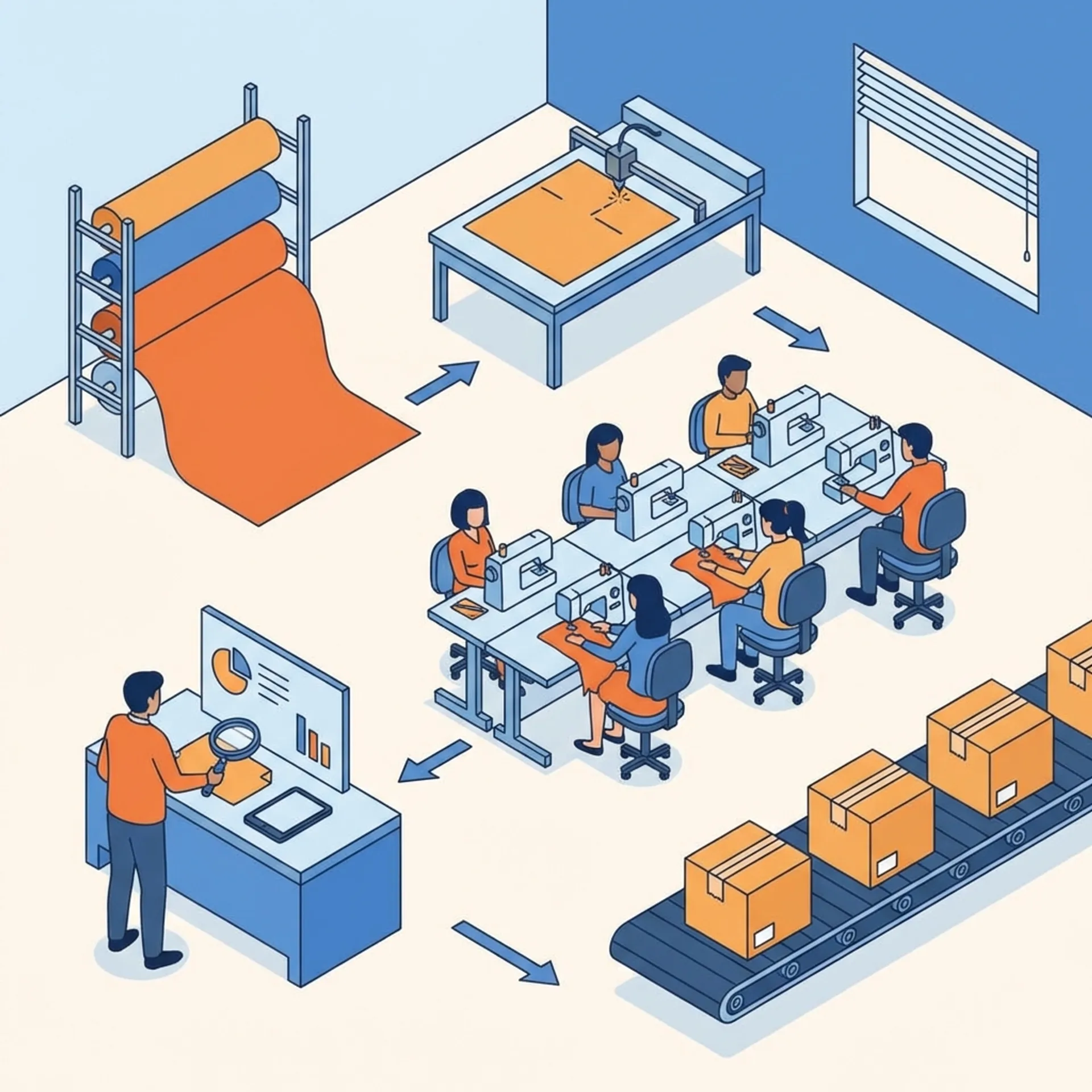
Who Is This Guide For?
If you run a garment manufacturing unit in India - whether a small stitching unit in Metiabruz or a large export house in Tirupur - this guide is for you.
I grew up in a garment manufacturing hub in Kolkata. I’ve seen firsthand how different manufacturers operate with completely different workflows. Some wait for orders before even touching fabric. Others design and produce first, then find buyers.
This guide categorizes the major types of garment manufacturers in India, outlines their specific manufacturing workflows, and links to detailed guides on optimizing each process.
The 3 Core Workflow Patterns
Before diving into manufacturer types, understand that all garment manufacturing in India follows one of three core workflow patterns:
| Pattern | How It Works | Who Uses It |
|---|---|---|
| Order-First | Receive order → Sample for approval → Production → Delivery | Export Houses, CMT, Job Work units |
| Sample-First | Design & create samples → Show to buyers → Approval → Production | ODM manufacturers, showroom-based units |
| In-House Direct | Design in-house → Produce stock → Sell to wholesalers/retailers/online | Own-label manufacturers, D2C brands, small-scale domestic units |
Your manufacturing workflow depends on which pattern you follow. Let’s look at each manufacturer type in detail.
Type 1: Export Houses
Workflow Pattern: Order-First
Export houses are large-scale manufacturers producing garments for international buyers. They follow the most structured workflow, driven by strict compliance requirements and buyer specifications.
The Export House Workflow
Order Inquiry → Costing & Negotiation → Order Confirmation
       ↓
Sample Development (Multiple Stages)
  → First Look Sample
  → Fit Sample (on live models)
  → Size Set Sample (all sizes)
  → Pre-Production Sample (PPS)
  → Buyer Approval
       ↓
Pre-Production
  → Fabric & Trim Sourcing
  → Fabric Testing & Approval
  → Pattern Making (CAD)
  → Marker Making
  → Pre-Production Meeting
       ↓
Production
  → Cutting → Sewing → Finishing
  → In-line Quality Control (IPQC)
  → Final Inspection (AQL)
       ↓
Packaging → Documentation → Shipment
Key Characteristics
- Production never starts without approved Pre-Production Sample (PPS)
- Multiple sampling stages (can take 4-8 weeks before bulk)
- Strict AQL-based quality inspections
- Requires compliance certifications (WRAP, SEDEX, BSCI)
- Heavy documentation for export (IEC, Bill of Lading, Certificate of Origin)
If you’re an export house, efficiency comes from streamlining your sampling cycle and reducing buyer approval turnaround times.
Type 2: CMT (Cut-Make-Trim) Manufacturers
Workflow Pattern: Order-First
CMT manufacturers handle only the core production - cutting, stitching, and trimming. The buyer provides all materials (fabric, trims, labels).
The CMT Workflow
Receive Materials from Buyer
  → Fabric + Trims + Accessories
  → Tech Pack + Patterns
       ↓
Pre-Production
  → Sample making (if required)
  → Buyer approval on construction
       ↓
Cutting
  → Marker Making (layout optimization)
  → Fabric Spreading (multiple layers)
  → Precision Cutting
  → Sorting & Bundling by size/color
       ↓
Making (Sewing)
  → Assembly line stitching
  → In-line quality checks
       ↓
Trimming
  → Attach buttons, zippers, labels
  → Thread trimming
  → Pressing/Ironing
       ↓
Quality Check → Packing → Handover to Buyer
Key Characteristics
- You don’t source materials - buyer provides everything
- Lower risk (no fabric investment) but tighter margins
- Focus is purely on production efficiency
- Pricing is per-piece based on labor + overhead
- Common for boutique brands, emerging designers, startups
If you’re a CMT unit, your competitive edge is production speed, stitching quality, and cost efficiency. You compete on execution, not sourcing.
Type 3: Job Work Manufacturers
Workflow Pattern: Order-First (for specific processes only)
Job work units specialize in one or few stages of production - stitching, embroidery, finishing, printing - rather than complete garment manufacturing.
The Job Work Workflow
Receive Job Order
  → Cut pieces OR semi-finished garments
  → Specifications for the required process
       ↓
Execute Specialized Process
  → Stitching (if stitching unit)
  → Embroidery (computerized or hand - Chikankari, Zari, Zardozi)
  → Printing (screen, digital)
  → Finishing (washing, pressing)
       ↓
Quality Check on Your Process
       ↓
Return to Principal Manufacturer/Buyer
Key Characteristics
- You handle only one stage of the manufacturing chain
- Work comes from larger manufacturers or brands outsourcing overflow
- Piece-rate or daily wage payment models
- Often operates on tight deadlines with variable workloads
- Critical to have skilled workers for your specialized process
If you’re a job work unit, your value is in your specialized skill and quick turnaround.
Type 4: FOB/Full-Package Manufacturers (OEM)
Workflow Pattern: Order-First
FOB (Free On Board) manufacturers provide end-to-end service - from sourcing materials to finished garment delivery at the port. They take on sourcing responsibilities that CMT doesn’t.
The FOB/OEM Workflow
Order Inquiry → Design Review → Costing (includes materials)
       ↓
Sample Development
  → Proto Sample
  → Fit Sample
  → PP Sample
  → Buyer Approval
       ↓
Material Sourcing (Manufacturer's Responsibility)
  → Fabric procurement
  → Trims, accessories, labels
  → Fabric testing
       ↓
Production
  → Cutting → Sewing → Finishing
  → In-process Quality Control
       ↓
Final QC → Packing → Local Logistics to Port → Shipment
Key Characteristics
- You source all materials - higher margins but more risk
- Buyer provides design; you handle everything else
- Need strong supplier relationships for fabric/trims
- Common for brands without sourcing infrastructure
- FOB pricing includes materials + production + logistics to port
If you’re an FOB manufacturer, your efficiency depends on both production AND your sourcing network.
Type 5: ODM (Original Design Manufacturer)
Workflow Pattern: Sample-First
ODM manufacturers design their own collections and then find buyers for them. The workflow reverses - you create first, sell second.
The ODM Workflow
Market Research & Trend Analysis
       ↓
Design Development
  → Sketching & Illustrations
  → Tech Pack Creation
       ↓
Material Sourcing (for samples)
       ↓
Sample Creation
  → Proto samples based on your designs
       ↓
Show to Buyers
  → Trade shows, showrooms, buyer visits
  → Buyers review your collection
       ↓
Buyer Selects Styles → Customization (if needed)
       ↓
Order Confirmation → Pre-Production Sample
       ↓
Bulk Production → Delivery
Key Characteristics
- You design first, then find buyers
- Higher creative control but need design capabilities
- Investment in samples before confirmed orders
- Faster for buyers (no design cycle needed)
- Common for trend-driven markets, fast fashion
If you’re an ODM, your samples ARE your sales pitch. Design quality and trend accuracy determine success.
Type 6: Own-Label / D2C Manufacturers
Workflow Pattern: In-House Direct
These manufacturers design, produce, and sell directly - either to wholesalers, retailers, or consumers. No external buyer approval needed before production.
The Own-Label Workflow
Trend Watching & Market Research
       ↓
Design Development (In-House)
  → Based on market demand, seasonal trends
  → Often simpler designs for volume production
       ↓
Material Sourcing
       ↓
Production
  → Cutting → Sewing → Finishing
  → Quality Control
       ↓
Inventory Stocking
       ↓
Sales Channels
  → Wholesale markets (Burrabazar, Surat)
  → Retail partners
  → E-commerce (Amazon, Meesho, own website)
  → Direct retail stores
Key Characteristics
- No waiting for buyer orders - you produce based on market prediction
- Full inventory risk - unsold stock is your problem
- Need market sensing ability to predict what sells
- Common in domestic readymade garment markets (Kolkata, Surat)
- D2C brands sell directly to consumers online
If you’re an own-label manufacturer, your success depends on trend prediction and inventory management.
The Ground Reality: Most Manufacturers Are Hybrids
Here’s what textbooks won’t tell you. In India, most garment manufacturers don’t fit neatly into one category.
A typical small-scale unit in Metiabruz might:
- Take job work orders for embroidery from export houses
- Do CMT production for a Delhi-based brand
- Produce their own designs and sell to Burrabazar wholesalers
They switch between workflow patterns based on what orders come in and what the market demands.
The key is knowing which workflow you’re operating in at any given time, so you can optimize accordingly.
Coming Up: Detailed Guides for Each Type
This guide gives you the overview. But each manufacturer type and each production stage deserves a deep dive.
Coming in this series:
- Detailed workflow guides for each manufacturer type
- Cutting operations - fabric spreading, marker optimization, cutting techniques
- Sewing line efficiency - line balancing, operator allocation, throughput
- Quality control - in-process vs final inspection, common defects
- Inventory management - tracking fabric, WIP, finished goods
Managing Your Manufacturing Workflow
Regardless of which type of manufacturer you are, workflow management is critical. This means:
- Tracking orders from inquiry to delivery
- Managing material inventory (fabric, trims, finished goods)
- Coordinating between departments (cutting, sewing, finishing)
- Monitoring production progress and bottlenecks
- Handling job work contractors
Modern garment ERP systems help streamline these operations. If you’re looking for software built specifically for Indian garment manufacturers, explore our garment manufacturing ERP.
Have questions about optimizing your specific manufacturing workflow? Get in touch.